
Panel brands
Canadian Solar panels in Melbourne: the TOPHiKu6 explained
Canadian Solar’s TOPHiKu6 (CS6.2-48TD) is an N-type TOPCon solar panel rated 445 to 475 W and up to 23.8% efficient: on a north-facing Melbourne roof one 475 W panel makes about 674 kWh a year (PVGIS). For panels installed in Australia it carries a 25-year product warranty and a 30-year performance warranty, and claims go to Canadian Solar’s office in Melbourne.
Our previous site listed it, and it is on our solar panel list; your written quote confirms the brand, model and wattage. Every rating on its datasheet is on the Clean Energy Council’s approved list.
Updated
Canadian Solar TOPHiKu6: datasheet specs
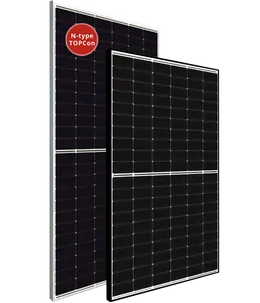
Canadian Solar rates the TOPHiKu6 CS6.2-48TD at 445 to 475 W. All 7 ratings are the same 1,762 × 1,134 mm panel, about 2.0 m², in 5 W steps. These are the figures from Canadian Solar’s own Australian datasheet (September 2025).
An all-black version of the same panel is rated 440 to 470 W and up to 23.5% efficient, with the same size, weight and warranty.
- Model
- CS6.2-48TD (black frame), ratings 445 to 475 W
- Efficiency
- 22.3% (445 W) to 23.8% (475 W)
- Power tolerance
- −5 W to +10 W of the rating
- Cells
- N-type TOPCon, monocrystalline, 144 [2 × (12 × 6)]
- Size and weight
- 1,762 × 1,134 × 30 mm, 24.6 kg
- Glass
- Front: 2.0 mm heat-strengthened glass with an anti-reflective coating. Back: 2.0 mm heat-strengthened glass
- Frame and junction box
- Anodised aluminium alloy; junction box IP68, 3 bypass diodes
- Temperature coefficients
- Power −0.29%/°C, voltage −0.25%/°C, current +0.045%/°C
- Nominal operating temperature (NMOT)
- 41 ± 3°C
- Hail, snow and wind
- Tested with 35 mm ice balls to IEC 61215; snow load up to 5,400 Pa, wind load up to 2,400 Pa (details in the installation manual)
- Working range
- −40°C to +85°C; maximum system voltage 1,500 V
- Made in
- China and Thailand
Source: Canadian Solar TOPHiKu6 CS6.2-48TD datasheet (black frame), V1.5_AU (September 2025) and the all-black datasheet, checked November 2026.
How efficient are Canadian Solar panels?
Efficiency is the share of the sunlight landing on a panel that it turns into electricity. The TOPHiKu6 runs from 22.3% at 445 W to 23.8% at 475 W. Because every rating is the same size, a higher rating simply puts more watts on the same patch of roof.
A kilowatt of panels makes about 1,419 kWh a year on a north-facing Melbourne roof, going by the PVGIS model for Mount Waverley, Melbourne (20° tilt, 14% system losses). So one 475 W TOPHiKu6 makes about 674 kWh a year, around 1.8 kWh a day on average.
On hot days
The TOPHiKu6 gives up 0.29% of its power for every degree its cells run above 25°C, the temperature behind its rating: about 2.9% for every 10 degrees. In the datasheet’s warmer, dimmer test (800 W/m² of sunlight, 20°C air) the cells reach about 41°C, which costs about 4.6%, and the 475 W panel delivers 359 W: most of that gap is the dimmer light.
| Rating | Efficiency | Output at NMOT |
|---|---|---|
| CS6.2-48TD-445 | 22.3% | 337 W |
| CS6.2-48TD-450 | 22.5% | 340 W |
| CS6.2-48TD-455 | 22.8% | 344 W |
| CS6.2-48TD-460 | 23.0% | 348 W |
| CS6.2-48TD-465 | 23.3% | 352 W |
| CS6.2-48TD-470 | 23.5% | 356 W |
| CS6.2-48TD-475 | 23.8% | 359 W |
Over the years
The performance warranty sets how fast the panel may age: no more than 1% lost in the first year, then no more than 0.4% a year, leaving at least 87.4% of the rated power after 30 years.
| End of year | Power guaranteed | 475 W panel | 445 W panel |
|---|---|---|---|
| Year 1 | At least 99% | 470 W | 441 W |
| Year 10 | At least 95.4% | 453 W | 425 W |
| Year 20 | At least 91.4% | 434 W | 407 W |
| Year 25 | At least 89.4% | 425 W | 398 W |
| Year 30 | At least 87.4% | 415 W | 389 W |
What does the Canadian Solar warranty cover?
Canadian Solar’s warranty for Australia and New Zealand has two parts. The 25-year product warranty covers defects in the panel’s materials and workmanship. The 30-year performance warranty guarantees the power above. Product warranty years depend on the model, so the model code on your quote matters:
| Product warranty | Models |
|---|---|
| 25 years | CS6.2-48TD in black frame and all-black (this panel), plus black-frame CS6.2-54TM and CS6.2-48TM |
| 25 years | CS6R (black frame and all-black) and black-frame CS6.1-54TD, on rooftops only |
| 15 years | CS6.2-54TD, and CS6.2-54TM other than the black-frame version |
| 12 years | Everything else the statement covers: CS6W, CS6.1-60TM, CS6.1-72TD, CS6.2-66TM and CS7L, and the models above in any frame colour or mounting the rows above don’t list |
- When it starts: the day after the panels are first installed, or 90 days after they are delivered, whichever comes first.
- If you sell the house: the warranty passes to whoever takes legal title to the panels, such as the buyer of your home, as long as the panels stay where they were first installed.
- Exclusions include: panels moved from where they were first installed; poor installation, or a design that leaves the panels constantly shaded; power failures and surges, flood, fire, lightning and accidental breakage; changes in appearance from normal wear, such as scratches, stains or discolouration.
- What Canadian Solar does: for a faulty panel it can repair the panels, replace them or refund their fair market value; for a shortfall in power it can repair or replace the panels, add panels to make up the lost watts or refund the value of the lost watts. Taking panels off the roof and refitting them stays the owner’s cost unless Canadian Solar agrees otherwise in writing.
- How to claim: in writing to Canadian Solar MSS (Australia) Pty Ltd, Technical Department, Level 27, 101 Collins Street, Melbourne, with the number of panels affected, their serial numbers and your purchase invoices, within the warranty period.
All of this sits on top of your rights under the Australian Consumer Law. The statement itself says: “Our goods come with guarantees that cannot be excluded under the Australian Consumer Law.”
Your quote sets out our workmanship warranty on the installation, which covers the work itself; Canadian Solar’s warranty covers the panels.
Canadian Solar in Australia: who stands behind the panel
Canadian Solar Inc. was founded in Canada in 2001, has its global headquarters in Kitchener, Ontario and has been listed on the NASDAQ since 2006. Its module business, CSI Solar, makes the panels and issues the warranty; the TOPHiKu6 CS6.2-48TD is manufactured and assembled in China and Thailand.
In Australia, Canadian Solar has an office at Level 27, 101 Collins Street, Melbourne, and its Australian site says it has over 50 employees around Australia. That office’s technical department takes warranty claims, so a Melbourne owner’s claim goes to an Australian company.
Canadian Solar says it has delivered nearly 180 GW of panels over 25 years and calls itself “Tier 1 by BloombergNEF and S&P Global”. Tier 1 is a BloombergNEF list of panel manufacturers whose panels banks have financed in large solar projects. It measures how bankable the maker is, not how good a particular panel is, so check the panel’s own warranties as well.
All 7 ratings on the datasheet are on the Clean Energy Council’s approved modules list (certificate 40057571): the 445 to 470 W listings run to 14 February 2028 and the 475 W listing runs to 28 January 2029. Being on that list is one of the conditions for STCs, the federal rebate on your quote. Search the approved list.
Canadian Solar vs the other panels we list
Here is the TOPHiKu6 beside the other panels we list, using each maker’s own datasheet and warranty terms. Our previous site listed these brands; your quote confirms the exact model.
| Panel | Power | Efficiency | Power lost per °C | Product warranty | Power at end of warranty |
|---|---|---|---|---|---|
| Canadian Solar TOPHiKu6 | 445 to 475 W | Up to 23.8% | 0.29% | 25 years (Australian warranty statement) | 87.4% after 30 years |
| REC Alpha Pure-RX | 450 to 470 W | Up to 22.6% | 0.24% | 20 years, or 25 years under REC ProTrust when an REC Certified Solar Professional installs and registers them | 92% after 25 years |
| Winaico NCX48 glass-glass | 465 W | Up to 23.3% | 0.28% | 30 years | 87.4% after 30 years |
| Phono Solar Helios | 435 to 440 W | Up to 22.53% | 0.26% | 30 years for homes (25 for commercial systems) | 88% after 30 years |
| Phono Solar Quasar | 475 W | Up to 23.27% | 0.26% | 30 years for homes (25 for commercial systems) | 88.5% after 30 years |
- Efficiency: at up to 23.8%, the TOPHiKu6 has the highest top efficiency in this list, so it fits the most watts on a given area of roof.
- Heat: REC Alpha Pure-RX (0.24%), Winaico NCX48 glass-glass (0.28%), Phono Solar Helios (0.26%) and Phono Solar Quasar (0.26%) lose less power per degree than the TOPHiKu6 (0.29%), so they give up a little less on hot afternoons.
- Warranty: Winaico NCX48 glass-glass, Phono Solar Helios and Phono Solar Quasar carry a longer product warranty than the TOPHiKu6’s 25 years. REC Alpha Pure-RX (92% after 25 years), Phono Solar Helios (88% after 30 years) and Phono Solar Quasar (88.5% after 30 years) guarantee more power at the end of the performance warranty.
JA Solar was in our previous panel range too. We haven’t confirmed its current Australian datasheet from JA Solar’s own site, so it isn’t in the table.
Roof space and price for a Canadian Solar system
Each TOPHiKu6 covers about 2.0 m², so a kilowatt of them needs about 4.2 to 4.5 m² of panel: around 28 to 30 m² for a 6.6kW system, before the gaps between rows and the clearances from the roof edges. Our package cards list a panel count for each size; your quote names the panel model and how many fit your roof. The 6.6kW system in detail.
We don’t publish package prices yet. The price depends on the system size, the battery, your roof and your switchboard, so we inspect the home and give you a fixed installed price that names the panel model and wattage, with the rebates already taken off.
Market data, not our price: the Solar Choice Price Index puts typical panels at about $80 to $300 or more each (October 2026), depending on the brand and wattage. The panels are only part of a system’s price; the solar panel cost guide covers the rest.
What to check on a Canadian Solar quote
- The full model code. Look for CS6.2-48TD and the wattage, for example CS6.2-48TD-475. The 25-year product warranty depends on it: many other TOPHiKu models get 15 or 12 years.
- Black frame or all-black. The 25-year warranty names these two versions, so check which one the quote gives. They are the same size; the all-black version tops out at 470 W instead of 475 W.
- Approved panels and inverter. The panels and the inverter must be on the Clean Energy Council’s list of approved products, which is another condition for STCs. Ask for the exact model numbers on the quote and check them.
- The inverter. The quote should name the inverter the panels feed, sized for the array. See how solar inverters compare.
- An accredited installer. The person who designs and installs the system must be accredited by Solar Accreditation Australia (SAA) and hold an unrestricted electrical licence in Victoria. Without that, the system cannot earn STCs, so the rebate on your quote depends on it. How we work.
- Paperwork for later. Keep the invoice and a list of the panel serial numbers: a warranty claim needs both.
Canadian Solar panels: your questions
Are Canadian Solar panels any good?
Judge the exact model on your quote. The TOPHiKu6 (CS6.2-48TD) is up to 23.8% efficient, carries a 25-year product warranty and a 30-year performance warranty for panels installed in Australia, and Canadian Solar has an office in Melbourne to claim against. Its trade-off is heat: it loses 0.29% of its power for each degree above 25°C, more than the REC Alpha Pure-RX, Winaico NCX48 glass-glass, Phono Solar Helios and Phono Solar Quasar. Compare the panels we list
Where are Canadian Solar panels made?
Canadian Solar Inc. was founded in Canada in 2001 and has its global headquarters in Kitchener, Ontario. Its panels are made by its module business, CSI Solar, and the Australian datasheet says the TOPHiKu6 CS6.2-48TD is manufactured and assembled in China and Thailand. The warranty for Australian buyers is handled from Canadian Solar’s office in Melbourne.
How long is the Canadian Solar panel warranty?
For the TOPHiKu6 CS6.2-48TD in black frame or all-black, 25 years on the panel itself and 30 years on its power: at least 99% of the rated output in year 1, losing no more than 0.4% a year after that, and at least 87.4% at year 30. Many other TOPHiKu models in the same Australian warranty statement get 15 or 12 years, so check the model code on your quote.
Does Canadian Solar have an office in Australia?
Yes. Canadian Solar’s Australian office is at Level 27, 101 Collins Street, Melbourne, and its Australian site says it has over 50 employees around Australia. Warranty claims for panels installed in Australia go in writing to the technical department there, with the panels’ serial numbers and your invoices.
How much power does a Canadian Solar panel produce in Melbourne?
About 674 kWh a year for a 475 W TOPHiKu6, or 1.8 kWh a day on average, on a north-facing Melbourne roof (PVGIS model, 20° tilt, 14% system losses). Summer days make well above the average and winter days well below it. A 445 W panel makes proportionally less. Estimate your savings
Is the Canadian Solar TOPHiKu6 bifacial?
No. The CS6.2-48TD has glass on the back as well as the front, which protects the cells, but it is rated on its front only: its datasheet gives no rear-side output and the Clean Energy Council’s approved list records it as not bifacial. Bifacial panels, which also collect light on the back, are a different design. Types of solar panels
Canadian Solar panels on a Melbourne roof
A Melbourne owner deals with Canadian Solar close to home: warranty claims go in writing to its technical department at Level 27, 101 Collins Street, Melbourne. Summer is where the TOPHiKu6 gives a little away. On a 35°C afternoon its cells run at about 56°C, going by its 41°C NMOT, and at 0.29% a degree that costs roughly 9.0% of its output. The Bureau of Meteorology’s Melbourne (Olympic Park) station averages 9.2 such days a year.
Over a year, roof direction matters more than that: in the PVGIS model for Mount Waverley, Melbourne, an east- or west-facing face makes about 13 to 14% less than a north-facing one. Our Mount Waverley team checks which faces suit the panels, and your quote confirms the panel brand, model and wattage.
Get a fixed price with the panel model named
Free inspection, no obligation. Every federal rebate your home qualifies for comes off before you see the price.

Ask us about Canadian Solar panels
Locally owned, locally installed. Call, email, or send the form and we’ll come out and inspect the property.
- Phone
- 0485 000 015
- Workshop
- 8/41 Ricketts Road,
Mount Waverley, VIC 3149