
Home batteries
Solar batteries in Melbourne
A solar battery stores the spare solar your panels make during the day, so your Melbourne home can run on it at night and, with a backup circuit, through a blackout. Our solar and battery packages pair solar with a 12.8 kWh battery for single phase homes and 16 kWh or more for three phase, and the federal battery rebate takes around 30% off the installed price.
We supply and install Sungrow and Alpha ESS batteries across Melbourne, on new solar or the system you already have.
Updated
How a solar battery works with your panels
Without a battery, any solar your home doesn’t use straight away goes out to the grid. A solar panel with battery keeps that power for later, so the evening and overnight load runs on your own solar instead of power you buy. A solar battery system has three parts: the panels, the battery and the inverter that manages both.
- Daytime: the panels power the home first, and the spare solar charges the battery.
- Battery full: any extra solar is exported to the grid, as it is now.
- Evening and night: the battery powers the home until it is empty, then the grid takes over.
- Blackout: with a backup circuit, the battery keeps your chosen circuits running.
A hybrid inverter runs the panels and the battery together: a DC coupled battery. A battery with its own inverter beside existing solar is AC coupled.
Adding a battery to the solar you already have
You don’t need new panels. A battery-ready hybrid inverter takes the battery directly; otherwise the battery gets its own inverter beside your system, or we swap in a hybrid when that works out better.
Batteries we install
We fit Sungrow and Alpha ESS home batteries. Both use lithium iron phosphate (LFP) cells and are built in modules, so your home energy storage can be sized to the power you use. Your written quote names the exact model, size and warranty.
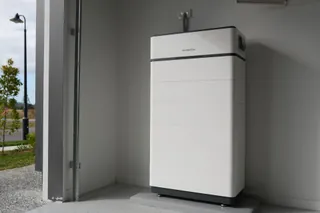
Sungrow SBR high-voltage battery
Stackable 3.2 kWh modules, so the battery is sized in small steps and can be extended later. It stands on the floor, so there is no heavy wall mounting.
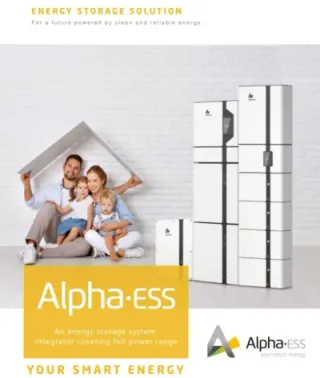
Alpha ESS SMILE-G3 home battery system
Battery and inverter designed as one system, with larger 9.3 kWh modules for homes that want more storage from fewer units.
| Battery | Usable capacity | Expansion | Where it can go | Warranty |
|---|---|---|---|---|
| Sungrow SBR high-voltage battery | 6.4 to 25.6 kWh per stack | 2 to 8 modules in one stack, added during its life | Indoor or outdoor, floor standing (IP55) | 10 years (conditions in Sungrow’s warranty letter) |
| Alpha ESS SMILE-G3 home battery system | 9.3 kWh per module (100% depth of discharge), up to 37.2 kWh | 1 to 4 modules (9.3 to 37.2 kWh) | Outdoor (IP65) | 10-year product warranty and 10-year battery performance warranty (at least 70% of usable capacity after 10 years) |
You follow what the panels make, what the battery stores and what the home uses in the maker’s app: iSolarCloud for Sungrow and the AlphaESS app for Alpha ESS.
Lithium-ion batteries for solar: chemistry, warranties and safety
Home solar batteries today are lithium-ion: the Clean Energy Council describes its approved list as over 1,000 lithium-based batteries. What differs between lithium battery storage systems is the cell chemistry: every one of the eight home batteries in our comparison, Sungrow and Alpha ESS included, uses lithium iron phosphate (LFP). Nickel manganese cobalt (NMC), another lithium-ion chemistry, is rare on the list: when we read every row in November 2026, the LG RESU6.5 was the only model labelled NMC.
Their warranties run 10 to 15 years, and every maker promises the battery still holds at least 70% of its capacity at 10 years. That is a guaranteed floor, not the day it stops working. Six of the eight warranties also set an energy or cycle limit that can end the guarantee sooner on a battery that cycles hard.
Safety rests on the cells, the battery’s own management system and where it goes: AS/NZS 5139:2019, the Australian standard for battery installations, keeps home batteries out of habitable rooms such as bedrooms and living areas, ceiling spaces, wall cavities and escape routes.
What size battery do you need?
Size the battery to the power you use after dark: lights, cooking, heating or cooling, hot water on a timer, and an EV if you charge at night. Bigger is not always better. A battery too large for your solar or inverter never fills, and the rebate now pays its full rate only on the first 14 kWh. Our battery size calculator suggests a size from your evening use and your solar.
| Solar | Power supply | Battery |
|---|---|---|
| 6.6kW Solar | Single Phase | 12.8kWh Battery |
| 15kW Solar | Single Phase | 12.8kWh Battery |
| 19.8kW Solar | Single Phase | 12.8kWh Battery |
| 15kW Solar | Three Phase | 16kWh+ Battery |
| 21kW Solar | Three Phase | 16kWh+ Battery |
| 28kW Solar | Three Phase | 16kWh+ Battery |
Not sure whether your home is single or three phase? Here’s how to tell.
How much does a solar battery cost?
Battery prices depend on the size, the brand, whether your switchboard needs work and whether the battery goes on new or existing solar. So we don’t publish a list price. We inspect the home and give you a fixed installed price with the federal rebate already taken off.
The battery rebate
The federal Cheaper Home Batteries Program takes around 30% off the cost of a home battery. It is paid as small-scale technology certificates (STCs), which we apply as an upfront discount on your quote. The amount is set by the battery’s usable capacity and the date it is installed: installs in May–December 2026 use a factor of 6.8, falling to 5.7 on 1 January 2027, and it keeps stepping down every six months until 2030.
| Usable capacity | Installed May–December 2026 | Installed January–June 2027 |
|---|---|---|
| 12.8 kWh | 87 STCs, about $3,300 | 72 STCs, about $2,700 |
| 16 kWh | 103 STCs, about $3,900 | 86 STCs, about $3,300 |
To qualify, the battery must be:
- installed by a Solar Accreditation Australia (SAA) accredited installer with battery endorsement
- a new battery on the Clean Energy Council approved battery list
- able to join a virtual power plant (VPP) if it is connected to the grid
There is one battery claim per property, and modules added later don’t get the rebate if the first battery already claimed it, so size the battery for your needs the first time.
All rebates, with our calculator
Virtual power plants in brief
A virtual power plant (VPP) links home batteries with smart software so they act like one power plant. You sign an agreement with a VPP operator, your battery shares stored power when the grid calls for it, and you get a credit or discount on your energy bill or a higher feed-in tariff, depending on the plan. The rebate only needs a battery that can join one: joining is your choice, at installation or later. The trade-off, as Solar Victoria puts it: the operator can draw on your battery at any time, which could shorten its life or affect its warranty. So check how often they can use it and any retailer contract or exit fee before you sign.
Blackout protection
A standard grid-connected solar system, with or without a battery, switches off in a blackout to protect the home from power surges and anyone working on the lines nearby (Solar Victoria). To keep the power on, the inverter needs a backup output and the home a backup circuit. The battery then runs the circuits wired to it, or the whole home on some inverters, until it runs low.
What the makers state for the batteries we fit:
- Sungrow SBR: through the Sungrow hybrid inverter; whole home on SH8.0RS, SH10RS and SH15T to SH25T.
- Alpha ESS SMILE-G3: backup (UPS) port for the circuits wired to it: 5 kVA single phase, 5 to 20 kVA three phase.
Your quote says whether your system is set up for backup and which circuits it covers.
When a home battery pays off
A battery earns its keep by replacing power you would buy in the evening with solar you would otherwise export. Victoria has had no minimum feed-in tariff since 1 July 2025, so exported solar earns only what your retailer chooses to pay, and keeping it is worth more than it used to be.
The case is strongest for homes that use a lot of power after dark and export a lot by day, and weakest when the house is empty most evenings.
How your electricity plan changes what a battery saves
On a flat rate, each kWh the battery covers saves the same: 25.96c to 31.98c on the Victorian Default Offer across Melbourne’s five networks. On time of use it covers the 4 pm to 9 pm peak, 37.57c to 47.64c. On the Midday Power Saver, grid power is free from 11 am to 2 pm, so the battery can also fill up for the evening. A virtual power plant pays you to share it instead.
Solar batteries: your questions
What is a solar battery?
A solar battery is a home battery that stores the solar power your panels make but your home doesn’t use straight away, so you can use it after dark instead of buying power from the grid. Every home battery in our comparison uses lithium iron phosphate (LFP) cells. An inverter turns the stored power into the mains power your appliances run on. Home batteries compared
How does a solar battery work?
During the day your panels power the home first, and the spare solar charges the battery instead of going to the grid. After sunset the battery powers the home until it is empty, then you buy from the grid as normal. A hybrid inverter, or a separate battery inverter on existing solar, controls the charging. AC vs DC coupled batteries
What size solar battery do I need?
Size it to the power you use after dark, not to the biggest battery that fits. Our packages use a 12.8 kWh battery for single phase homes and 16 kWh or more for three phase. The federal rebate now pays its full rate only on the first 14 kWh, 60% from 14 to 28 kWh and 15% from 28 to 50 kWh, so very large batteries get less help per kWh. Battery size calculator
How much does the rebate take off a battery?
For a 12.8 kWh battery installed in May–December 2026, the federal rebate is up to about $3,300, at $38 per STC. The installed price itself depends on the battery size, the brand, your switchboard and whether it goes on new or existing solar, so we give you a fixed price after a free inspection, with the rebate already taken off. See the battery cost guide
What does a home battery system include?
The solar panels (new, or the ones you already have), the battery modules and an inverter that manages both: a hybrid that runs the panels and battery together, or a separate battery inverter beside existing solar. For power in a blackout you also need a backup circuit, because a standard system switches off in an outage. How a battery is installed
How do I choose a home battery brand?
Compare usable capacity, power, the warranty (its years, the capacity it guarantees at 10 years and any energy or cycle limit), blackout backup, and whether the model is on the Clean Energy Council approved batteries list, which the rebate requires. Our comparison sets eight home batteries side by side from the makers’ own documents, and your written quote names the exact model. Compare home batteries
What a home battery means in Melbourne
Victoria’s own help for home batteries has ended. Solar Victoria’s battery rebates ran from 2019 to 2023, and it has closed applications for its interest-free battery loans, so a Melbourne home buying a battery now plans around the federal rebate above alone. What the battery earns you depends on your street’s network. CitiPower, Powercor and United Energy plan to lower their fixed export limit to 1.5 kW per phase during 2026–31, with flexible exports instead, so on those networks more of a sunny day’s spare solar is worth storing for the evening than sending out. At a free inspection our Mount Waverley team checks your network’s rules, your switchboard and where the battery can go.
Get a battery quote
Free inspection, no obligation. Every federal rebate your home qualifies for comes off before you see the price.

Talk to us about a home battery
Locally owned, locally installed. Call, email, or send the form and we’ll come out and inspect the property.
- Phone
- 0485 000 015
- Workshop
- 8/41 Ricketts Road,
Mount Waverley, VIC 3149