
Inverter brands
Sungrow hybrid inverters in Melbourne
Sungrow’s current hybrid inverters for Melbourne homes come in two ranges: the single phase SH-RS, from 5 to 10 kW, and the three phase SH-T, from 5 to 25 kW. Each runs your panels and a Sungrow battery from one box, and Sungrow covers it for 10 years from installation in Australia. On a single phase Melbourne home, where each of the five networks pre-approves up to 10 kW of inverter, the largest that fits is the SH10RS. Compare them with other brands in our solar inverters guide.
Our previous website listed Sungrow inverters; which brands we install today is being confirmed, and your quote names the exact model. Below: every model, how many panels each takes, and pairing it with a battery.
Updated
Sungrow SH-RS and SH-T hybrid inverters
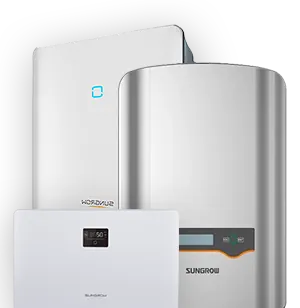
A Sungrow hybrid inverter does two jobs: it turns the panels’ DC power into the AC your home uses, and it charges and runs a Sungrow battery, now or added later. The SH-RS is the single phase range (SH5.0RS, SH6.0RS, SH8.0RS and SH10RS). The SH-T is the three phase range (SH5T, SH10T, SH15T, SH20T and SH25T), which spreads its output across all three phases.
Every model switches to backup in under 10 ms, is rated IP65 against dust and water, and reports to Sungrow’s iSolarCloud app. What changes with size is how many panels it takes, how fast it charges a battery and how much of the home it backs up.
| Model | Phase | Rated output | Panels it takes | MPP trackers | Battery charge / discharge | Blackout backup | Approved list until |
|---|---|---|---|---|---|---|---|
| SH5.0RS Datasheet: Sungrow SH5.0/6.0RS datasheet (AU, V14) | Single phase | 5 kW | Up to 12 kWp | 2 | 6.6 / 6.6 kW | Chosen circuits, up to 6 kW | 30 January 2028 |
| SH6.0RS Datasheet: Sungrow SH5.0/6.0RS datasheet (AU, V14) | Single phase | 6 kW | Up to 13 kWp | 2 | 6.6 / 6.6 kW | Chosen circuits, up to 6 kW | 30 January 2028 |
| SH8.0RS Datasheet: Sungrow SH8.0/10RS datasheet (V6, 2026) | Single phase | 8 kW | Up to 16 kWp | 4 | 10 / 10 kW | Whole home, through a 63 A bypass | 29 June 2029 |
| SH10RS Datasheet: Sungrow SH8.0/10RS datasheet (V6, 2026) | Single phase | 10 kW | Up to 20 kWp | 4 | 10 / 10 kW | Whole home, through a 63 A bypass | 29 June 2029 |
| SH5T Datasheet: Sungrow SH5/10T datasheet (V3) | Three phase | 5 kW | Up to 10 kWp | 2 | 15 / 5 kW | Whole home, 63 A bypass on each phase | 14 August 2027 |
| SH10T Datasheet: Sungrow SH5/10T datasheet (V3) | Three phase | 10 kW | Up to 20 kWp | 2 | 15 / 10 kW | Whole home, 63 A bypass on each phase | 14 August 2027 |
| SH15T Datasheet: Sungrow SH15/20/25T datasheet (AU, V3) | Three phase | 15 kW | Up to 30 kWp | 3 | 30 / 15 kW | Whole home, 63 A bypass on each phase | 18 April 2027 |
| SH20T Datasheet: Sungrow SH15/20/25T datasheet (AU, V3) | Three phase | 20 kW | Up to 40 kWp | 3 | 30 / 20 kW | Whole home, 63 A bypass on each phase | 18 April 2027 |
| SH25T Datasheet: Sungrow SH15/20/25T datasheet (AU, V3) | Three phase | 25 kW | Up to 50 kWp | 3 | 30 / 25 kW | Whole home, 63 A bypass on each phase | 18 April 2027 |
The inverter must be on that approved list for the system to earn STCs, the federal solar rebate, so check the exact model on your quote. Sungrow Australia’s home range page also names 6 kW, 8 kW and 12 kW SH-T models, but its datasheet and the approved list cover only the SH5T and SH10T.
Earlier and solar-only models: SH-RT and SG-RS
You may already have one of these. The SH-RT (SH5.0RT and SH10RT) is Sungrow’s earlier three phase hybrid. It no longer appears on Sungrow Australia’s hybrid range, but it is on the approved list until 17 December 2027, and Sungrow’s 10-year warranty names the SH5.0RT, SH8.0RT and SH10RT.
The SG-RS (SG5.0RS, SG8.0RS and SG10RS) is Sungrow’s solar-only string inverter: the approved list files it as a “Grid Connect PV Inverter” with no battery port, listed until 7 July 2028. Adding a battery to an SG system means either a battery with its own inverter (AC coupling) or swapping the SG for a hybrid.
What size Sungrow inverter do you need?
Start with your supply. A single phase home takes an SH-RS: every Victorian network pre-approves up to 10 kW of inverter on one phase, so the SH10RS is the largest. A three phase home takes an SH-T, up to the networks’ 30 kW three phase limit, which the SH25T fits within. Battery inverters count toward those totals.
Single or three phase: how to tell
How many panels each model takes
Every Sungrow hybrid can run more panels than its own rating, within two limits under the SAA Technical Requirements (version 1.9, February 2026). Without a battery, the inverter’s output must be at least 75% of the panels’ peak power. With a battery connected, the panels can go past that ratio, but never past the maker’s own maximum.
| Model | Rated output | Without a battery | With a battery connected |
|---|---|---|---|
| SH5.0RS | 5 kW | Up to 6.67 kWp | Up to 12 kWp (240%) |
| SH6.0RS | 6 kW | Up to 8 kWp | Up to 13 kWp (217%) |
| SH8.0RS | 8 kW | Up to 10.67 kWp | Up to 16 kWp (200%) |
| SH10RS | 10 kW | Up to 13.33 kWp | Up to 20 kWp (200%) |
| SH5T | 5 kW | Up to 6.67 kWp | Up to 10 kWp (200%) |
| SH10T | 10 kW | Up to 13.33 kWp | Up to 20 kWp (200%) |
| SH15T | 15 kW | Up to 20 kWp | Up to 30 kWp (200%) |
| SH20T | 20 kW | Up to 26.67 kWp | Up to 40 kWp (200%) |
| SH25T | 25 kW | Up to 33.33 kWp | Up to 50 kWp (200%) |
One catch on the smaller single phase models: Sungrow Australia’s product page headlines a 150% DC/AC ratio for the SH5.0RS and SH6.0RS, which is 7.5 kWp and 9 kWp of panels, lower than the datasheet figures above. An array within 150% sits inside both, so ask your installer which figure the design uses.
Our packages, measured against Sungrow’s limits
Our single phase packages name the inverter by size, not make (see our packages below). Here is how each package’s array sits against the same-size Sungrow:
- 6.6 kWp of panels on a 5 kW inverter (132%): within the SAA ratio, so it works with or without a battery, and within the SH5.0RS’s limit.
- 15 kWp of panels on a 10 kW inverter (150%): past the SAA ratio, so only with a battery connected, and within the SH10RS’s 20 kWp limit.
- 19.8 kWp of panels on a 10 kW inverter (198%): past the SAA ratio, so only with a battery connected, and within the SH10RS’s 20 kWp limit.
More trackers help on a complicated roof. The SH8.0RS and SH10RS have 4 MPP trackers, so panels on several roof faces can each run at their own best voltage; the SH5.0RS and SH6.0RS have 2.
Pairing a Sungrow inverter with an SBR battery
Sungrow’s product pages list its SBH, SBR and SBS050 batteries for the SH-RS and its SBH and SBR batteries for the SH-T. The SBR is built from 3.2 kWh modules, 2 to 8 in a stack (6.4 to 25.6 kWh usable), and up to 4 stacks on one inverter with an extra combiner box.
| Phase | Inverters | Source |
|---|---|---|
| Single phase | SH3.0RS, SH3.6RS, SH4.0RS, SH5.0RS and SH6.0RS | SBR user manual |
| Single phase | SH8.0RS and SH10RS | Sungrow Australia: “fully compatible with … SBR series” |
| Three phase | SH5.0RT, SH6.0RT, SH8.0RT and SH10RT | SBR user manual |
| Three phase | SH5T to SH25T (SBR096 and larger) | SH-T user manual |
- The smallest stack has limits. The two-module SBR064 (6.4 kWh) works only with the SH3.0RS to SH6.0RS (single phase) and SH5.0RT to SH10RT (three phase). The SH8.0RS, SH10RS and every SH-T start at the SBR096 (9.6 kWh).
- Charging speed. The inverter charges and discharges a battery at up to 6.6 kW (30 A) on the SH5.0RS and SH6.0RS; 10 kW (50 A) on the SH8.0RS and SH10RS. The SH-T charges at up to 15 kW on the SH5T and SH10T; 30 kW on the SH15T, SH20T and SH25T. The battery has its own rating too, from 3.84 kW (SBR064) to 15.36 kW (SBR256), and the lower of the two sets the pace.
- The rebate. The Cheaper Home Batteries Program needs a battery on the Clean Energy Council approved list. The SBR is listed until 30 December 2026 (BAT-474), so check its status when you book the install.
Sungrow SBR battery: sizes and rebate
Backup in a blackout
With a battery connected, every Sungrow hybrid can keep power on in a blackout, switching over in under 10 ms. How much of the home it covers depends on the model:
- SH5.0RS and SH6.0RS: chosen circuits, up to 6 kW.
- SH8.0RS and SH10RS: the whole home, through a 63 A bypass, with a peak of 13.68 kVA for 10 seconds.
- SH-T (SH5T, SH10T, SH15T, SH20T and SH25T): the whole home, 63 A bypass on each phase, and Sungrow supports 100% unbalanced output in backup, so the three phases don’t need equal loads.
iSolarCloud monitoring
Every Sungrow hybrid reports to iSolarCloud, on the app and the web: what the panels make, what the home uses, the battery’s charge and any fault codes, with the SH-RS sending fresh data every 10 seconds. Keeping it online matters for more than the graphs:
- Victoria’s emergency backstop. Since 1 October 2024, new and replacement solar systems need a compatible (CSIP-AUS certified) inverter on the CEC approved list and a reliable internet connection. Without internet, a lower export limit applies; if the inverter drops off, exports are automatically reduced until it reconnects.
- The battery warranty. Sungrow’s SBR warranty requires the battery to be monitored in iSolarCloud.
- The Wi-Fi dongle. It counts as an accessory, so Sungrow’s warranty covers it for 1 year from installation, not the inverter’s 10.
If iSolarCloud shows the system offline, the inverter may have lost its Wi-Fi connection, for example after a new router. The reconnect steps are in our monitoring guide.
Sungrow inverter warranty and service in Australia
Sungrow’s inverter warranty runs 10 years from installation in Australia (at most 11 years from manufacture). It names every SH-RS and SH-T model in the table above, the earlier SH-RT and the SG string inverters, and it transfers to a new owner with the original proof of purchase. It is given by Sungrow Australia Group Pty Ltd in North Sydney, the Australian importer for Sungrow Power Supply Co., Ltd.
- Accessories: the Wi-Fi dongle and the smart energy meter are covered for 1 year from installation (at most 2 years from manufacture).
- Extensions: can be bought up to the end of the standard 10-year warranty, as parts only (the replacement part) or standard cover (parts plus Sungrow’s standard freight and labour rebate). They cover the inverter only.
- Claims: start with your installer, who does the first troubleshooting. Then the owner or the installer can lodge Sungrow’s online warranty claim at service.sungrowpower.com.au, with your invoice, receipt or commissioning report; Sungrow recommends finding a local electrician when the installer can’t attend.
The warranty sits on top of your consumer rights: Sungrow’s own terms say its goods come with guarantees that cannot be excluded under the Australian Consumer Law. Full terms: Sungrow’s Inverters 10-Year Limited Warranty.
Your quote sets out our workmanship warranty on the installation, alongside Sungrow’s.
Sungrow or another brand?
Fronius’s GEN24 Plus is the closest match: a single or three phase hybrid of similar sizes. The practical differences are the battery, the panels and the backup:
- The battery. Sungrow lists its own batteries for its hybrids (SBH, SBR and SBS050 on the SH-RS), and the SBR runs only on a Sungrow hybrid. Fronius names Fronius Reserva, BYD Battery-Box Premium HVS/HVM and LG RESU FLEX for the GEN24 Plus.
- Panels per inverter. The SH8.0RS and SH10RS take up to 200% of their rating in panels; a Fronius GEN24 takes up to 150% (a 5 kW model takes 7.5 kWp, a 10 kW model 15 kWp).
- Blackout backup. With a battery, every SH-T and the SH8.0RS and SH10RS switch the whole home over in under 10 ms. A GEN24 Plus offers whole-home Full Backup too: with a battery and the Fronius Backup Controller, the inverter switches the whole home to backup power automatically, within 10 seconds. Without a battery, its PV Point still gives up to 3 kVA from the panels during a blackout.
Sources: Sungrow’s datasheets (linked in the model table above), Fronius’s GEN24 technical data (checked October 2026) and Fronius Australia’s GEN24 Plus technical data (checked November 2026).
Sungrow inverters and our packages
Our single phase packages list a 5 kW or 10 kW hybrid inverter. Which make and model goes into each package is being confirmed, so your quote names the inverter, its datasheet limit and where your array sits within it.
A package price depends on the inverter, the battery size and your switchboard, so we give you a fixed price after a free inspection, with every federal rebate your home qualifies for already taken off.
Sungrow inverters: your questions
Is Sungrow a good inverter brand?
We don’t rate brands, so judge it on what you can check. Every current Sungrow hybrid on this page is on the Clean Energy Council approved inverter list (the earliest listing runs to 18 April 2027), each carries a 10-year warranty from installation in Australia, given by Sungrow Australia Group Pty Ltd, and each is rated IP65. Whether one suits you depends on your phase, your array and your battery plans. Every model compared
What is the difference between the Sungrow SH5.0RS and SH10RS?
Size and headroom. The SH5.0RS is a 5 kW single phase hybrid with 2 MPP trackers, up to 12 kWp of panels on its datasheet and 6.6 kW of battery charging. The SH10RS is 10 kW with 4 trackers, up to 20 kWp and 10 kW. In a blackout the SH10RS backs up the whole home, through a 63 A bypass; the SH5.0RS backs up chosen circuits, up to 6 kW. Sizing a Sungrow inverter
How many solar panels can a Sungrow SH10RS take?
Up to 20 kWp with a battery connected, Sungrow’s datasheet limit: about 42 to 45 panels of 435 to 475 W. Without a battery, the SAA rule that the inverter’s output must be at least 75% of the panels’ peak power caps it at about 13.33 kWp (28 to 30 panels). Every Victorian network pre-approves up to 10 kW of inverter on a single phase home, so the SH10RS is the largest single phase Sungrow hybrid that fits. Panels each model takes
How long is the Sungrow inverter warranty?
10 years from installation in Australia (at most 11 years from manufacture), for the SH-RS, SH-T, the earlier SH-RT and the SG string inverters. It transfers to a new owner with the original proof of purchase. Accessories such as the Wi-Fi dongle and the smart energy meter are covered for 1 year from installation. You can buy an extension up to the end of the standard 10-year warranty: parts only (the replacement part) or standard cover (parts plus Sungrow’s standard freight and labour rebate). Warranty and service
Can a Sungrow hybrid inverter work without a battery?
Yes. It runs as an ordinary solar inverter, and a compatible Sungrow battery can be connected later without changing the inverter. Until then the panels must stay within the SAA ratio, up to about 133% of the inverter’s rating (6.67 kWp on an SH5.0RS). Once a battery is connected, the array can go up to Sungrow’s own limit for the model. Sungrow SBR batteries
What replaced the Sungrow SH10RT?
Sungrow Australia’s range now lists the SH5T and SH10T and the SH15T to SH25T for three phase homes; the SH-RT no longer appears there. The SH5.0RT and SH10RT stay on the approved inverter list until 17 December 2027, Sungrow’s 10-year warranty still names the SH-RT, and Sungrow’s SBR manual lists the SH-RT as compatible, so an existing one can take an SBR battery. The SH-RT and SG-RS
Where are Sungrow inverters made?
Sungrow Power Supply Co., Ltd is based in Hefei, China, and every current Sungrow hybrid datasheet lists China as the country of manufacture. In Australia the warranty is given by Sungrow Australia Group Pty Ltd, based in North Sydney, which takes claims through its online service portal. If your inverter shows a fault, start with your installer, who does the first troubleshooting. Inverter faults and repairs
Sizing a Sungrow for a Melbourne roof and network
Beyond the 10 kW single phase ceiling above, two Melbourne facts shape a Sungrow choice. The first is exports: each network’s pre-approval limits what you can send to the grid, and CitiPower, Powercor and United Energy plan to lower their fixed export limits during 2026–31 and offer flexible exports instead. The SH8.0RS and SH10RS take up to 200% of their rating in panels, so a big array can make more at midday than the network lets you export: the rest is used at home, stored in a battery or curtailed. The second is the roof. On the PVGIS model for Mount Waverley, Melbourne, an east- or west-facing array makes about 86–87% of a north-facing one over a year, so east and west faces are worth using when north runs out of room, and the SH8.0RS and SH10RS give them 4 trackers to the 2 on the SH5.0RS and SH6.0RS.
Get a Sungrow inverter quoted
Free inspection, no obligation. Every federal rebate your home qualifies for comes off before you see the price.

Talk to us about a Sungrow inverter
Locally owned, locally installed. Call, email, or send the form and we’ll come out and inspect the property.
- Phone
- 0485 000 015
- Workshop
- 8/41 Ricketts Road,
Mount Waverley, VIC 3149