
Battery installation
Solar battery installation in Melbourne
A solar battery installation in Melbourne runs in five steps: an inspection of your home, a design and fixed quote, the network and rebate paperwork, install day, then an independent safety inspection before the battery is switched on. We install home batteries across Melbourne, with new solar or on the system you already have: see the batteries we install.
Where it goes is set by AS/NZS 5139:2019 and its Amendment 1: never in a bedroom or living area, a ceiling space or a wall cavity, and protected from cars in a garage or carport. The installer must hold Solar Accreditation Australia accreditation with a battery endorsement for the federal rebate.
Updated
How we install your battery
Every home battery installation follows the same steps, whether the battery goes in with new solar or onto the system you already have.
- Site inspection. We look at your switchboard, your existing solar and inverter (if any), your power bills and where the battery can go.
- Design and quote. We size the battery to your evening use, choose DC or AC coupling, and give you a fixed price with every federal rebate your home qualifies for already taken off.
- Approvals and rebate paperwork. We get your electricity distributor’s pre-approval where it is needed and create the rebate certificates (STCs) for the battery.
- Install day. The battery is mounted, protected where the spot needs it, wired to the inverter and switchboard, and labelled.
- Inspection, commissioning and app setup. An independent licensed electrical inspector checks the work, the system is switched on and tested, and we set up the monitoring app with you.
Your quote gives your install date and how long the team will be on site.
If you already have solar panels
Most homes with solar can add a battery. A battery-ready hybrid inverter takes a compatible battery as it is (DC coupling). Otherwise the battery comes with its own inverter and connects at the switchboard (AC coupling), or the old inverter is replaced with a hybrid. For the federal rebate, only the inverter the battery connects to has to be able to join a virtual power plant, and your existing panels don’t need to be on the approved list.
Where can a solar battery go under AS/NZS 5139:2019?
AS/NZS 5139:2019 (Electrical installations – Safety of battery systems for use with power conversion equipment) is the Australian standard for home battery installations, and Amendment 1 to it was published on 19 December 2025. Standards Australia sells it, so few homeowners read it; Solar Victoria’s free technical guidance sheets explain the parts that matter, and this page draws on them. For the federal rebate the Clean Energy Regulator names the standard, state electrical safety laws and Solar Accreditation Australia’s technical requirements; the Clean Energy Council’s part is its approved battery list. The battery maker’s installation manual adds its own conditions on top. A battery is not allowed:
- inside a habitable room: a bedroom, living room, kitchen, dining room, study or any room that could become one.
- in a ceiling space or wall cavity.
- on a roof, unless there is a permanent ladder or stairway to it.
- under a stairway or access walkway, or in an escape route.
Solar battery clearance requirements
The standard keeps clearance zones around exits and doorways; windows and vents that serve a living area; and other appliances, such as a hot water unit or an air conditioner. Amendment 1 changed some of them: a battery may now sit within 600 mm of an opening wider than 900 mm, such as a garage door, and an inverter now counts as an associated appliance, so it may sit within the restricted zone. Because the distances changed, we measure the spot against the current standard at the inspection rather than quote old figures.
A wall with a bedroom or living room behind it
A battery can go on a wall with a habitable room on the other side, but the wall must be non-combustible, or a non-combustible barrier must be fitted between the battery and the wall. Solar Victoria’s guidance lists brick or masonry block, concrete, compressed cement sheeting and ceramic or terracotta tiles as materials that count without a fire test, and Amendment 1 adds that they must be at least 6 mm thick. Glass windows and corrugated steel sheeting don’t count unless tested.
Sources: Solar Victoria, Technical guidance sheet 2.2: Protection against the spread of fire and restricted locations; Building Commission NSW on Amendment 1. Checked October 2026.
Garage, outside wall or carport?
A home battery usually goes in one of three places. Each can work if the battery is rated for it and the spot meets the rules above.
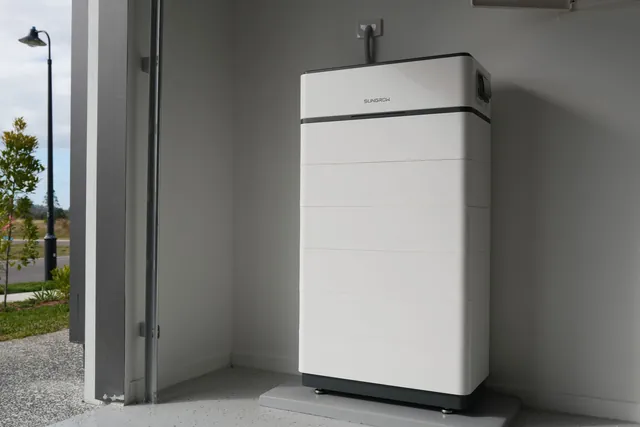
In the garage
A garage keeps the battery out of the sun and rain: the NSW regulator’s note on the standard lists garages among the shaded spots to choose. The catch is cars: where a vehicle can reach the battery, it needs fixed impact protection (below). Amendment 1 also helps here: a battery may now sit within 600 mm of an opening wider than 900 mm, such as a garage door.
On an outside wall
The battery must be rated for outdoor use and the wall shaded. The spot must be clear of the zones around doors, windows that serve living areas and appliances such as the hot water unit or air conditioner, and a wall with a bedroom behind it needs a non-combustible barrier.
Under a carport
Shade and some rain cover, but a car parks there, so the battery needs the same impact protection as in a garage. An open side still lets weather in, so its rating must suit.
Does a solar battery need a bollard?
If a car can reach it, yes, or another fixed barrier. Solar Victoria’s guidance for installers, reviewed by Energy Safe Victoria, says that where a vehicle could enter the space, “suitable fixed vehicle mechanical protection must be installed”, whatever the owner keeps there today. It also shows what falls short:
- Movable shelving, benches or cupboards, because they could be moved later.
- Mounting the battery higher than the bonnet of your current car, because an SUV reversing in, a visitor’s van or ute, or a trailer or boat stored later can still reach it.
- One bollard in the middle, which leaves both sides exposed: the suggested fix is two bollards, one either side of the battery, or a U-shaped barrier across the front.
A battery in the front corner of a typical 6 m garage, behind a solid pillar or wall, may not need a bollard. As a guide, the pillar shields about 2.5 times its width along the wall: a 500 mm pillar covers about 1,250 mm. If a car can drive past the battery, its trailing edge may need a bollard too.
These examples date from 2023, before Amendment 1, and Solar Victoria notes that some standards may have changed since. We assess each garage and carport at the inspection, and any bollard the spot needs is part of your quote.
Source: Solar Victoria, Technical guidance sheet 2.1: Physical protection of battery systems. Checked November 2026.
Can a solar battery be installed outside?
Yes, if the maker rates it for outdoor use and the spot is out of direct sun. Solar Victoria’s guidance says equipment rated below IP33 must be protected from water getting in, for example under a waterproof overhang; an IP30 battery has no water protection at all. All 8 batteries in our battery comparison are listed for outdoor use on the Clean Energy Council’s approved list.
| Battery | Where it can go | Listed for outdoor use |
|---|---|---|
| Sungrow SBR | Indoor or outdoor, floor standing (IP55) | Yes |
| Alpha ESS SMILE-G3 | Outdoor (IP65) | Yes |
Direct sun and heat
The NSW electrical regulator’s note on AS/NZS 5139:2019 says it requires battery systems to be “installed in locations that protect them from direct sunlight and vermin”, because exposure “can lead to overheating, battery degradation and damage to equipment or associated wiring”. Its advice is to avoid north-facing areas or locations exposed to morning or afternoon sunlight without shading or protection, and to choose south-facing areas, under carports or inside garages, or fit awnings or screens approved by the manufacturer where needed. Each maker also sets the temperatures its battery charges and runs in.
How heat and cold affect a battery
Battery enclosures and storage boxes
A home battery comes in its own enclosure, and that enclosure carries its weather (IP) rating, so a rated battery needs no extra box. Any cover, screen or awning added for shade or rain should be one the maker approves: makers set installation conditions above the standard’s minimum. Shade cloth isn’t waterproof, so it doesn’t count as rain cover. Lockable boxes sold for small 12-volt or camping batteries are a different product.
Unused cable entries are sealed with the maker’s bungs or kits, to keep vermin out and keep the IP rating, and the NSW note advises running battery cables in at least medium duty conduit.
Sources: Solar Victoria, sheet 2.1; Building Commission NSW, Environmental requirements for battery systems. Checked November 2026.
Battery installation rules in Victoria: what your installer must certify
In Victoria a home battery is electrical installation work under the Electricity Safety Act 1998, done by a Registered Electrical Contractor and Licensed Electrical Workers to AS/NZS 5139:2019, AS/NZS 4777.1:2024 and AS/NZS 3000:2018. It is also prescribed work: an independent licensed electrical inspector must inspect it, and it cannot be turned on until then.
| Check | The rule | What you get |
|---|---|---|
| Accredited installer | Installed by a Solar Accreditation Australia (SAA) accredited installer with battery endorsement; the work is done by a Registered Electrical Contractor and Licensed Electrical Workers. | Ask to see their accreditation and licence. If the accredited installer isn’t there all day, they should be on site for job setup, mid-install and commissioning. |
| Approved battery | A new battery on the Clean Energy Council approved battery list, able to join a virtual power plant (VPP) if it is connected to the grid. | The exact model on your quote, so you can check it against the list. |
| Network approval | Pre-approval from your distributor (CitiPower, Powercor, Jemena, AusNet or United Energy) where it needs one. | Arranged by the installer before the battery connects. |
| Installed to the standard | AS/NZS 5139:2019 with Amendment 1, Solar Accreditation Australia’s technical requirements and the maker’s manual. | A physical copy of the battery’s safety data sheet, protected from damage (for example in a sealed, durable clear pouch). |
| Safety inspection | An independent Licensed Electrical Inspector inspects it before it is switched on (prescribed electrical work). | A Certificate of Electrical Safety. |
| Rebate paperwork | STCs on the battery’s usable capacity; the battery stays at the property for the warranty period or until the end of 2030, whichever is later. | Written documentation about the battery and its installation. |
Home battery installation compliance in Australia
The accreditation and approved-battery rules are the same in every state, because they are conditions of the federal Cheaper Home Batteries Program, which also needs the battery installed to AS/NZS 5139:2019 and state electrical safety laws, and allows one battery claim per property.
After the install
The Clean Energy Regulator inspects a sample of rebated installs; its inspections are voluntary and can only go ahead with your written consent. It also advises a safety check every year by a licensed electrician accredited by Solar Accreditation Australia. We service and repair solar systems across Melbourne.
Our accreditation and warranty
Your quote lists the accreditation and battery endorsement of the installer doing your job, and the manufacturer’s warranty for the battery you choose.
What a good battery installation looks like
Passing inspection is the floor. A good installation is also easy to understand, service and shut down in an emergency. Solar Victoria’s guidance says: “Correct battery labelling supports servicing by technicians and emergency services if responding to potential incidents.”
Signs and labels
Under AS/NZS 5139:2019, putting up the labels is the installer’s job. Solar Victoria’s labelling sheet lists what a lithium battery installation should show:
- At the meter box and switchboard: a green reflective circle marked “ES”, with the UN number of the battery chemistry underneath (such as UN3480), at least 100 mm across, “to provide vital information to any approaching emergency worker”; and a map at the main switchboard showing where the battery is, if it is hard to find.
- A shutdown procedure: a site-specific shutdown procedure, next to the inverter the battery connects to and visible from the switches it tells you to operate.
- Its safety data sheet: a physical copy of the battery’s safety data sheet, kept in the main meter box or switchboard, near the shutdown procedure, in a sealed, durable clear pouch.
- Labelled parts: the battery isolator marked “BATTERY SYSTEM D.C. ISOLATOR”, and the battery cables marked “BATTERY” at least every 2 m where you can see them.
Signs should last as long as the battery, stay readable in the sun, and not be hidden inside cupboards or behind doors, because firefighters and the next electrician rely on them.
Cables, communications and access
Battery cables run in at least medium duty conduit where they need protection, and communication cables don’t have the battery cables’ insulation, so they run in their own conduit or are kept apart: the cable to the meter that tells the battery what your home uses, and its internet connection. A good installer also leaves room to replace a module or the whole unit later without moving everything else.
Sources: Solar Victoria, Technical guidance sheet 2.4: Labelling requirements; Technical guidance sheet 2.3: Protection of wiring and wiring systems; Notice to Market 2025–26. These date from before Amendment 1. Checked November 2026.
Before the installer leaves
This is the battery part of the handover; the solar items are in our solar handover pack. Before the installer goes, check you have:
- A Certificate of Electrical Safety from the independent inspection.
- The battery online in the maker’s app, in your name. Solar Victoria’s rules for its battery loans had installers connect it to the internet at commissioning, or through a phone hotspot to register it, for software updates to resolve safety and performance issues.
- The mode and backup reserve set as you agreed, and shown to you in the app.
- A backup changeover test, where backup is fitted: the grid switched off, the backed-up circuits still running (how backup works).
- The warranty registered, with the terms of the warranties and who to contact if the system or a product fails, and the serial numbers of the battery and inverter on your paperwork for any recall check.
- The signs and the safety data sheet in place, as above.
Common problems after a battery install
- The internet drops out. All eight battery warranties we compared want the battery registered, monitored or online, and a virtual power plant needs it online too. If the app shows it offline, fix the Wi-Fi or ask about a wired connection.
- The figures look backwards. If the app shows the battery charging from the grid when the sun is out, or your home exporting at night, the meter that measures your grid power may be on the wrong cable or facing the wrong way. Ask the installer to check it.
- It doesn’t fill in winter. PVGIS models a north-facing 6.6 kW system in Melbourne at about 14.4 kWh a day in June, against 34.9 in January, so a battery that fills every summer day may not in June. That is sizing, not a fault (the season-by-season example).
Solar battery installation cost
The installation is part of the battery’s installed price: one quote covers the battery, the work and any extras, with every federal rebate your home qualifies for taken off. Extras that can add to the job are a bollard, a switchboard upgrade, a backup circuit, a longer cable run and, on existing solar, a second inverter for an AC coupled battery.
Market data, not our price: in the Solar Choice Battery Price Index, August 2026 (national averages after the rebate), adding an inverter to connect the battery to existing solar added about $500 to $1,500 to the average installed price, depending on the battery size.
Switchboard work a battery may need
A battery changes where some circuits get their power. Energy Safe Victoria’s guidance for electricians on battery energy storage systems (BESS) starts from this: “By installing a BESS, you are altering the source of supply to existing circuit(s).” So any circuit the battery supplies in a blackout must have suitable RCD (safety switch) protection, of the type the inverter maker specifies; with partial backup, only the circuits on the inverter’s backup output count as altered. An older switchboard without room for the new breakers or without safety switches may need an upgrade, which your quote lists as an extra.
Areas we install
Need a solar battery installer near you? From our Mount Waverley base we install home batteries across metropolitan Melbourne: the eastern, south-eastern, northern and western suburbs and the Mornington Peninsula.
Battery installation: your questions
How long does a battery install take?
Most of the work happens on install day: mounting the battery, wiring it to the inverter and switchboard, then testing and commissioning. Before that we inspect your home, design the system and arrange the approvals, and your quote gives the install date. In Victoria a home battery is prescribed electrical work, so it cannot be turned on until an independent licensed electrical inspector has inspected it.
Which room is the best place for a home battery?
Usually a garage, a carport or an outside wall, as long as the battery is rated for the spot. AS/NZS 5139:2019 does not allow a battery inside a habitable room such as a bedroom, living room, kitchen or study, or in a ceiling space or wall cavity. On a wall with a bedroom or living room behind it, the wall must be non-combustible, or a non-combustible barrier must be fitted between the battery and the wall. We confirm the spot at the inspection.
Does an outdoor battery need shade from the sun?
Yes. AS/NZS 5139:2019 requires a battery to be protected from direct sunlight, so a north-facing wall in full sun is a poor spot; a south-facing wall, a carport, a garage or an awning the maker approves keeps it shaded. It must also be rated for outdoor use: Solar Victoria’s installer guidance says equipment rated below IP33 must be protected from water getting in. Outdoor ratings and enclosures
Does a battery in the garage need a bollard?
If a car can reach it, it needs fixed impact protection, usually one or more bollards. Shelving and mounting it above bonnet height don’t count. A battery in the front corner of a typical 6 m garage, behind a solid pillar or wall, may not need one, but if a car can drive past it the far edge may need a bollard too. We assess the garage at the inspection and put any bollard in the quote. Bollards and impact protection
Do I need a storage box or cabinet for a home battery?
Usually not. A home battery comes in its own enclosure, and that enclosure carries the weather (IP) rating, so a rated battery can stand in a garage or on an outside wall as it is. Any cover, screen or awning added for shade or rain should be one the maker approves, because the maker’s installation conditions apply on top of the standard.
What paperwork should I get after a battery is installed?
A Certificate of Electrical Safety from the independent inspection, a physical copy of the battery’s safety data sheet (which Amendment 1 to the standard requires), and written documentation about the battery and its installation, which the Clean Energy Regulator says every owner must receive. Keep them with the battery’s warranty details. Before the installer leaves
Getting a battery installed in Melbourne
Three Victorian steps sit around a Melbourne battery install. Your network (AusNet Services, CitiPower, Jemena, Powercor or United Energy) pre-approves the connection where it needs to, and the installer arranges it. The work is prescribed electrical work, so an independent licensed electrical inspector checks it before switch-on and you get a Certificate of Electrical Safety. And if the battery goes in a garage under the home’s roof, Solar Victoria’s rules for its solar battery loans required a smoke alarm in that room, which the standard recommends anyway (smoke alarms and batteries).
At a free inspection our Mount Waverley team looks at your switchboard and measures the garage or wall against AS/NZS 5139:2019, so your quote says where the battery will go.
Book a battery inspection
Free inspection, no obligation. Every federal rebate your home qualifies for comes off before you see the price.

Talk to us about installing a battery
Locally owned, locally installed. Call, email, or send the form and we’ll come out and inspect the property.
- Phone
- 0485 000 015
- Workshop
- 8/41 Ricketts Road,
Mount Waverley, VIC 3149